
The 2027 Benefits Strategy: Why Better Access to Care Matters More Than Cost-Shifting
According to PwC's 2027 medical cost trend analysis, commercial group medical costs are projected to rise 9% in 2027—the highest medical cost trend in 17 years.
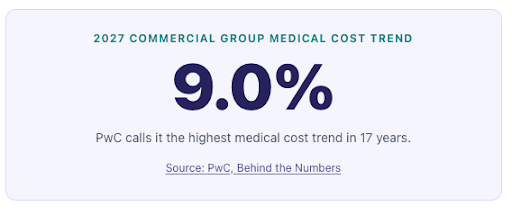
But care costs are skyrocketing for everyone. While employers are forced to navigate astronomical premium increases, employees and their families face higher costs at the point of care, too.
What happens when employees can't afford—or can't easily access—the care they need?
Higher deductibles and other forms of cost sharing can reduce healthcare utilization. When faced with unprecedented care costs, people don't always cut out unnecessary care. Sometimes they delay care they desperately need. And oftentimes, they don’t know the difference.
According to KFF's research on healthcare affordability, 36% of U.S. adults say they've skipped or postponed needed healthcare because of cost. Even among people with health insurance, 37% report delaying or going without needed care because of cost.
And cost is only one barrier. As we've explored before, many working adults don't have a primary care provider because of challenges such as time, availability, ever-changing networks or insurance coverage, and a healthcare system that doesn't always fit into everyday life.
That's why a sustainable healthcare cost strategy has to consider more than cost
It also has to consider how easy it is for them to get the right care.
Rising costs put employers in a difficult position
Employers heading into 2027 are facing two competing pressures: keep health benefit spending under control while also keeping healthcare affordable for employees. But the cost has to be paid somewhere.
Mercer's 2027 benefits planning guidance says employers are looking closely at high-cost claims, pharmacy spending, affordability, vendor performance, and where employees receive care.
One traditional response to rising costs has been to shift more of the expense to employees through deductibles, copays, and coinsurance.
That may reduce utilization. But financial barriers don't neatly distinguish between unnecessary care and necessary care.
Someone worried about the price of an appointment may delay addressing a persistent symptom. A person managing a chronic condition may put off a follow-up visit.
For employers looking for more sustainable ways to manage spending, the goal shouldn't simply be less care.
It should be helping employees get the right care, at the right time, in the right setting.
Earlier care can change where the healthcare journey goes next
Employers can’t predict and prevent every high-cost claim, but they can help people enter the healthcare system when they need to so those claims don’t pile up.
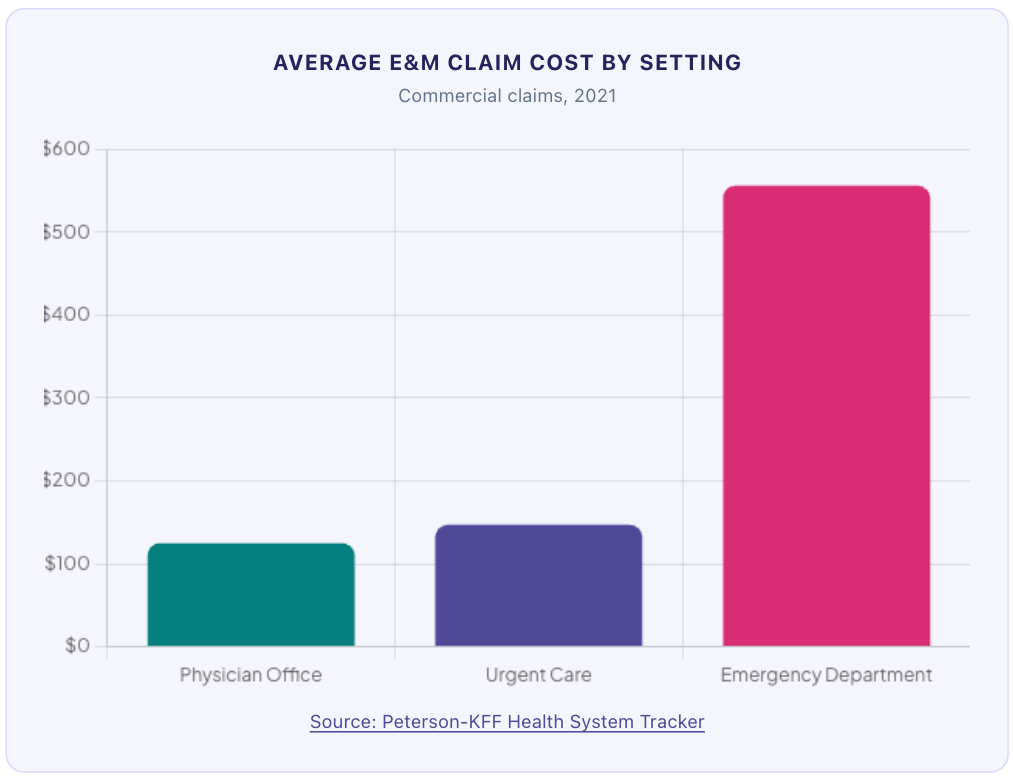
Where people get care has a huge impact on cost. A Peterson-KFF Health System Tracker analysis of commercial claims found that in 2021, the average evaluation-and-management claim varied by care setting and cost:
$125 in an outpatient physician office
$147 in urgent care
$556 in an emergency department
That's about 4.5 times more for the evaluation-and-management portion of an emergency department visit than an office visit.
Of course, emergencies belong in the emergency department. But non-emergencies often end up there too, and that’s big, unnecessary spending.
That can be especially important for chronic conditions.
According to the CDC's high blood pressure data, nearly half of U.S. adults have high blood pressure, yet only about one in four adults with the condition has it under control.
A study published in JAMA Internal Medicine found that among patients with two or more chronic conditions, team-based primary care was associated with 25.2% fewer emergency department visits and 18.6% fewer hospitalizations compared with patients at comparison practices.
Routine primary care helps creates opportunities to identify risks like these, start treatment, monitor progress, and adjust care over time, keeping people out of the emergency room and saving costs for employees and employers alike.
One place to start can make healthcare easier to use
Adding more healthcare benefits doesn't necessarily make healthcare easier.
Employees may already have a health plan, telehealth vendor, mental health benefit, pharmacy coverage, physical therapy options, and other point solutions.
The challenge is knowing which one to use, when to use it, and what happens next.
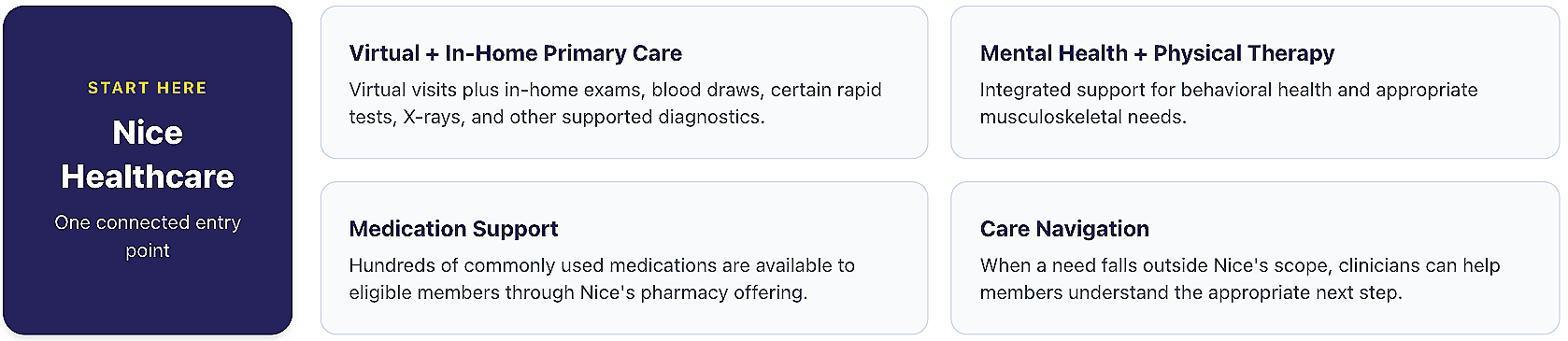
Nice Healthcare gives eligible employees and dependents one place to start for their everyday healthcare needs.
Members can access primary care, mental health therapy, physical therapy, labs and diagnostic services, medication support, and care navigation. When something falls outside Nice's scope, the care team can help guide the member toward the appropriate next step.
For many concerns, a virtual visit may be enough. When it's not, Nice also offers in-person services such as physical exams, blood draws, certain rapid tests, X-rays, and other supported diagnostics. This can often be done in the home, or even in places of work.
This combination of virtual and in-person care is what makes hybrid primary care different from traditional healthcare: members can start virtually while still having access to in-person services when needed
Nice also offers specialized programs for conditions including hypertension, diabetes, weight management, and perimenopause and menopause.
Nice's integrated model also brings primary care, medication management, mental health, and physical therapy together, for whole-person care. Nice's nurse-led care model offers a closer look at how that coordination can support continuity across different health needs.
A 2025 JAMA Network Open study of an employer-sponsored behavioral health program found that access to the program was associated with $190 in reduced medical claims costs for every $100 invested, or an estimated $1,070 in net savings per participant during the first year.
While the study wasn't conducted on Nice members specifically, it reinforces a broader point: easier access to services like behavioral health can affect whole-person care, and not behavioral health alone.
Location matters for planned care, too
Beyond the ER department, hospital-based imaging and other services are also significantly more expensive than the same care at an office or imaging center.
A 2026 Health Care Cost Institute analysis of imaging services among people with employer-sponsored insurance found that imaging performed in hospital outpatient departments cost roughly two to four times more than comparable imaging performed in physician offices.
For example:
Lower-complexity imaging averaged $61 in a physician office versus $227 in a hospital outpatient department.
Higher-complexity imaging averaged $387 in a physician office versus $1,416 in a hospital outpatient department.
Routine lab work shows the same pattern.
In a separate Health Care Cost Institute analysis of laboratory prices, a comprehensive metabolic panel averaged $8.35 in an independent lab versus $51.17 in a hospital outpatient department.

Hospital outpatient departments accounted for just 29% of lab use in HCCI's employer-sponsored population—but 60% of total lab spending.
That's why care navigation can be an important part of a cost management strategy.
What can better access look like in the real world?
When employers find solutions that get people the right care, at the right time, in the right place, the results speak for themselves.
Palenque Cocina y Agaveria, a family-owned restaurant in Littleton, Colorado, provides one example.
Like many small employers, Palenque was trying to balance strong health benefits with rising healthcare costs. The company offered a level-funded health plan, which meant unused claims dollars could be returned to the employer.
Palenque's benefits broker recommended adding Nice Healthcare, and the company launched the benefit in May 2021.
According to Nice Healthcare's Palenque case study, the company's health plan had an 85% loss ratio in the year before implementation.
In its first year with Nice, that fell to 15%—an 82.4% relative decrease. The following year, it fell again to 9%.
Because Palenque's level-funded plan returned unused claims dollars, the company received:
$20,011 back in the first year
$19,312 back in the second year
$39,323 in total health plan refunds
After accounting for Palenque's investment in Nice, the case study calculated an 11:1 return on investment.

Health plan design, workforce health needs, baseline utilization, geography, network costs, and other factors can all affect claims spending. But offering convenient, easy-to-access care is a great start.
A few common questions
Does Nice replace health insurance?
No. Nice Healthcare works alongside an employer's health plan rather than replacing major medical coverage. Because each Nice appointment is an avoided claim, overall care costs go down.
Does Nice work with an HSA-eligible high-deductible health plan?
Yes. Nice Healthcare is HSA-compatible and can be offered alongside a high-deductible health plan.
Employers interested in how recent federal changes affect this type of benefits design can read more about what H.R. 1 means for primary care, HSAs, and employer health benefits.
What happens when a member needs something Nice can't provide?
Nice clinicians can help members understand the appropriate next step when their needs fall outside Nice's scope, giving them a trusted place to start rather than leaving them to navigate the healthcare system alone.
The 2027 cost conversation should be about more than shifting costs
While employers can't eliminate serious illness, predict every high-cost claim, or determine what hospitals and pharmaceutical companies charge, they can provide a convenient front door to care, so members always know where to go.
Instead of simply asking employees to pay more and use less care, employers can ask a better question:
How can we make it easier for people to use the right care before healthcare becomes harder—and potentially more expensive—to manage?
Make primary care part of your 2027 benefits strategy
See how Nice Healthcare can give your employees an easier place to start,and help you build a benefits strategy around better access, smarter navigation, and measurable value.
